May Is Mental Health Awareness Month | Here Is What The White House Is Doing In 2023!

MENTAL HEALTH STILL A CONCERN FOR 2023
Mental Health Awareness Month has been observed in the U.S. since 1949. Every year during the month of May, NAMI joins the national movement to raise awareness about mental health. Together, we fight stigma, provide support, educate the public and advocate for policies that support the millions of people in the U.S. affected by mental illness.

Nearly one in five Americans lives with a mental health condition, according to the National Institute of Mental Health.


That includes any mental, behavioral, or emotional disorder such as:

  • Depression
  • Anxiety
  • Mood disorders, including bipolar disorder
  • Personality disorders
  • Psychotic disorders, including schizophrenia
  • Trauma
  • Eating disorders
  • Substance -use disorders

A recent statement by President Joe Biden on Mental Health Awareness Month mentions isolation, sickness, grief, and job loss as contributing factors on declining mental health as well as lack of access to mental health services during difficult times.


The White House issued a statement in 2023:

“During National Mental Health Awareness Month, we honor the absolute courage of the tens of millions of Americans living with mental health conditions, and we celebrate the loved ones and mental health professionals who are there for them every day.  Treatment works, and there is no shame in seeking it.  Together, we will keep fighting to get everyone access to the care they need to live full and happy lives.”


They report the latest statistics which are another reason to promote mental health and promote treatment:


“Two in five adults report anxiety and depression, and two in five teens describe experiencing persistent sadness or hopelessness, exacerbated by social media, bullying, and gun violence.  Drug overdose deaths are also near record highs, and suicide is the second leading cause of death among young people.”


They have also issued funds to provide more help and resources for those suffering in their mental health:

“It takes an average of 11 years to get treatment after the onset of symptoms, and less than half of Americans struggling with mental illness ever receive the care they need.


Last year, we also launched 988 as the Nation’s new Suicide and Crisis Lifeline so anyone in the midst of a crisis can receive life-saving confidential help right away.  We added dedicated counselors trained in supporting LGBTQI+ youth to the 988 lifeline, and for veterans, we made it easier to reach the Veterans Crisis Line by dialing 988 and pressing 1 to reach trained crisis responders.”

To read the entire report issued by the White House, click here.

The Door SwitchTM wants to continue the fight for more awareness and provide additional resources to dispel the myths about mental health issues and solutions for safety issues. We also continue to strive to provide a product that keeps the hospital environment safe. We continue to be committed to better practices and procedures in the mental health community. For information concerning our safety product, please click here.
If you are in crisis or are experiencing difficult or suicidal thoughts, call the National Suicide Hotline at 1-800-273 TALK (8255).

Sincerely,

The Door SwitchTM

April Is Stress Awareness Month | Here Is How We Can Help!

STRESS INCREASES IN 2023 OVER 2022
More than one in four (26%) reported they anticipated experiencing more stress at the start of 2023, up from one in five (20%) last year. At the same time, 29% American adults indicated they’d adopt new year’s resolutions related to their mental health, up three percentage points from last year.
The 1st of April marks the beginning of this month-long annual campaign to shine a light on the importance of managing stress and increasing our resilience long before it affects our mental health or causes mental illness.
Stress and poor mental health are one of the biggest public health challenges that we’re facing today. Sadly, even though that is the case, society is still not taking its impact seriously enough. We continue to separate mental health from physical health and vice versa.
There is no health without mental health and stress can lead to numerous health problems, such as physical problems, like heart disease, insomnia, digestive issues, immune system challenges, etc., to more serious mental health disorders such as anxiety and depression.
Stress Awareness Month has been held every April since 1992.  One of the goals is to help remove the guilt, shame, and stigma around mental health.

A 2017 study from the APA (American Psychological Association) found the most common sources of stress reported among Americans was the “future of our nation” (63% of respondents mentioned), money (62%), work (61%), political climate (57%), violence/crime (51%).

Stress Awareness month exists to create an open conversation on the impact of stress. Everyone experiences levels of stress, but the impacts of stress can quickly lead to mental health issues.
When stress becomes overwhelming, here are some coping techniques we can keep in mind:
  • Recognize when you don’t have control, and let it go.
  • Avoid getting anxious about situations that you cannot change.
  • Take control of your reactions and focus your mind on something that makes you feel calm and in control.
  • Develop a vision for healthy living, wellness, and personal growth, and set realistic goals to help you realize your vision.
What else can we do for Stress Awareness Month?
1.) Talk about it! Talking about stress and its effects can alleviate the stigma of this “do-it-all” attitude.
2.) Share coping mechanisms.
3.) Look after yourself.  We all need to consider more self-care.

The most crucial thing you can do when you are stressed or anxious is to make sure you are continuing to look after yourself. Make time to relax when you need to and learn to say no to requests that are too much for you.

Avoiding excessive substance abuse and alcohol, exercising, and taking care of your body, connecting with others, and taking time to unwind are all good tips to cope with stress.

The Door SwitchTM wants to continue the fight for more awareness and provide additional resources to dispel the myths about mental health issues and solutions for safety issues. We also continue to strive to provide a product that keeps the hospital environment safe. We continue to be committed to better practices and procedures in the mental health community. For information concerning our safety product, please click here.

If you are in crisis or are experiencing difficult or suicidal thoughts, call the National Suicide Hotline at 1-800-273 TALK (8255).

Sincerely,

The Door SwitchTM

CDC Reports: Dramatic Rise in Poor Mental Health For Teen Girls

ADOLESCENT MENTAL HEALTH CONTINUES TO WORSEN
Nearly all indicators of poor mental health and suicidal thoughts and behaviors increased from 2011 to 2021. In 2021, more than 4 in 10 (42%) students felt persistently sad or hopeless and nearly one-third (29%) experienced poor mental health. In 2021, 22% of high school students seriously considered attempting suicide, 18% made a suicide plan and 10% attempted suicide.
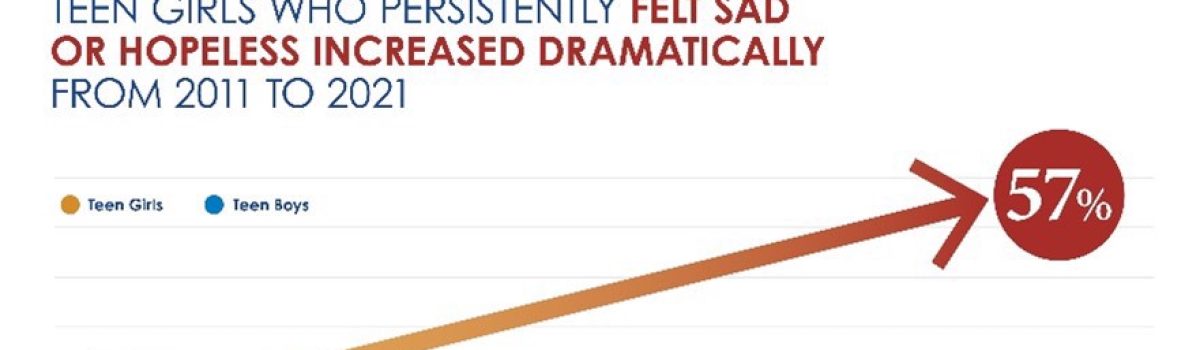
Results from the CDC’s 2021 Youth Risk Behavior Survey show startling trends. While all teens reported increasing mental health challenges, experiences of violence, and suicidal thoughts and behaviors. Nearly 3 in 5 teen girls (57%) said they felt “persistently sad or hopeless.” That is the highest rate in a decade. And 30% said they have seriously considered dying by suicide (up from 19%) — a percentage that’s risen by nearly 60% over the past 10 years. Read the full report here.
While all teens reported increasing mental health challenges, experiences of violence, and suicidal thoughts and behaviors.
“Our teenage girls are suffering through an overwhelming wave of violence and trauma, and it’s affecting their mental health,” said Kathleen Ethier, director of the CDC’s Division of Adolescent and School Health.
“High school should be a time for trailblazing, not trauma. These data show our kids need far more support to cope, hope, and thrive,” Debra Houry, M.D., M.P.H., CDC’s Chief Medical Officer and Deputy Director for Program and Science. “Proven school prevention programs can offer teens a vital lifeline in these growing waves of trauma.”
There was improvement for adolescents in some areas, such as risky sexual behavior, substance abuse and bullying, but mental health and suicidal thoughts as well as experiences of violence worsened, the data showed.
What can we do?
“Young people are experiencing a level of distress that calls on us to act with urgency and compassion,” said CDC Division of Adolescent and School Health Director Kathleen Ethier, Ph.D. “With the right programs and services in place, schools have the unique ability to help our youth flourish.”
School-based activities can make a profound difference in the lives of teens with a relatively small infusion of support to schools. More than 95% of U.S. youth spend much of their daily lives in school. While their primary goal is academic learning, schools can take evidence-based steps to foster the knowledge, skills and support needed to help prevent and reduce the negative impact of violence and other trauma and improve mental health.The CDC began conducting the Youth Risk Behavior Survey in 1991. A total of 17,508 students completed the 99-question survey for 2021. The data is a go-to source for the prevalence of drug and alcohol use, teen sex behavior, bullying and other things identified over the years as health-risk factors.

The Door SwitchTM wants to continue the fight for more awareness and provide additional resources to dispel the myths about mental health issues and solutions for safety issues. We also continue to strive to provide a product that keeps the hospital environment safe. We continue to be committed to better practices and procedures in the mental health community. For information concerning our safety product, please click here.

If you are in crisis or are experiencing difficult or suicidal thoughts, call the National Suicide Hotline at 1-800-273 TALK (8255).

Sincerely,

The Door SwitchTM

How to Combat the Winter Blues & Is ‘Blue Monday’ Real?

If you are online looking up mental health in January, chances are you are running across blogs sharing tips for how people can avoid depression and the gloom that comes with this month.  The concept of “Blue Monday” – the third Monday in January – claimed that it was the most depressing day of the year.  This concept has since been disproven for a variety of reasons, one being that it tried to measure subjective data, such as the most common date people quit their New Year’s resolutions and the weather.
But the concept of “Blue Monday,” however unscientific, does give awareness to another very scientific occurrence of the overall incline of depression in winter months.
“There is generally more sadness in the winter time and January is not uncommon at all for overall more sadness among folks,” said Dr. Ravi Shah, a psychiatrist at Columbia University’s Irving Medical Center in New York City. “ So rather than dial in to one specific day, I think the more interesting question is what it is about the winter that affects our mood.”  
The winter blues are real. It’s more clinically known as seasonal affective disorder, or SAD. It’s a form of depression that people experience usually during the fall and winter months when there is less sunlight. The most difficult months for people with SAD in the US tend to be January and February, but it improves with the arrival of spring.

Psychology Today reported that SAD is estimated to affect 10 million Americans, and that another 10% to 20% may have mild symptoms. For 5% of adults who experience SAD, for about 40% of the year they have symptoms that can be overwhelming and can interfere with their daily lives.

The condition has been linked to a biochemical imbalance in the brain prompted by shorter daylight hours and less sunlight in winter. As seasons change, people experience a shift in their biological internal clock, or circadian rhythm, that can cause them to be out of sync with their regular schedule.

Common symptoms of SAD include fatigue despite how much a person sleeps, and weight gain associated with overeating and carbohydrate cravings, according to the American Psychiatric Association.

Other signs include feelings of sadness, loss of interest in activities once enjoyed, feelings of worthlessness or guilt, trouble concentrating or making decisions, thoughts of death or suicide, and even suicide attempts.

The onset of SAD can occur at any age, but typically starts between the ages of 18 and 30 and is more common in women than in men.

What can we do to combat the winter blues?
Keep active. Research has shown that a daily one-hour walk in the middle of the day could be as helpful as light treatment for coping with the winter blues.
Get outside. …
Keep warm. …
Eat healthily. …
See the light. …
Take up a new hobby. …
See your friends and family. …
Talk it through.
The Door SwitchTM wants to continue the fight for more awareness and provide additional resources to dispel the myths about mental health issues and solutions for safety issues. We also continue to strive to provide a product that keeps the hospital environment safe. We continue to be committed to better practices and procedures in the mental health community. For information concerning our safety product, please click here.

If you are in crisis or are experiencing difficult or suicidal thoughts, call the National Suicide Hotline at 1-800-273 TALK (8255).

Sincerely,

The Door SwitchTM

Happy Holidays From Your Friends at The Door Switch & 7 Ways to Make Your Holidays a Little Brighter!

HOLIDAYS CAN BE DIFFICULT FOR THOSE SUFFERING WITH A MENTAL DISORDER. 
While the holiday season can be the most anticipated time of year for many, it can be equally as painful for those suffering with a mental disorder and can perhaps be the most difficult time to be in an inpatient facility.
Here are seven suggestions for making the holidays a little more enjoyable for patients, visitors and staff at your facility:
1. Serve up some holiday classics
For many people, it’s just not the holidays until you get to enjoy your favorite seasonal dish.2. Wear festive attire
Though a new holiday uniform may not be a feasible option, adding some holiday flair–such as reindeer antlers, a santa hat or an ‘ugly Christmas sweater’– helps to spread the holiday joy to all you encounter.

3. Deliver holiday cards to patients
A special note on a food tray delivery or a season’s greetings card left behind by a housekeeper lets patients know that others are thinking of them during the holiday season.
4. Provide diet-approved sweet treats
Hot chocolate, warm apple cider and pumpkin pie all help to ring in the holiday season. For patients on sugar-free diets, arranging fruit or vegetables in the shape of turkey or Christmas tree can serve as a healthier yet festive option.
5. Build a thankful board
Find a common area to share a posting board for staff, visitors and patients to share what they are thankful for. Messages of thanks during a difficult time can go a long way in providing hope.
6. Bring the decorations inside
Setting up Christmas trees, holiday lights, menorahs and more will bring a festive atmosphere into the halls of your facility.
7. Call in the carolers
Bringing Christmas carolers or Santa Claus to visit with patients is a great way to share some holiday spirit and spread well-wishes across the facility.
The Door SwitchTM wants to continue the fight for more awareness and provide additional resources to dispel the myths about mental health issues and solutions for safety issues. We also continue to strive to provide a product that keeps the hospital environment safe. We continue to be committed to better practices and procedures in the mental health community. For information concerning our safety product, please click here.

If you are in crisis or are experiencing difficult or suicidal thoughts, call the National Suicide Hotline at 1-800-273 TALK (8255).

Sincerely,

The Door SwitchTM

Honoring Our Veterans & What We All Need To Know About Today

Celebrating Veterans Day:
FIVE QUESTIONS TO ASK A VETERAN – FIVE WAYS TO SUPPORT VETERANS
WHAT WE ALL NEED TO KNOW ABOUT VETERANS DAY:
There are few key things we need to know about Veterans Day.
First, why is Veterans Day on the 11th and does not change?
World War 1 ended on the 11th month of the 11th day on the 11th hour.
Poppies are a significant flower for Veterans Day. The red represents the blood of all those who gave their lives, the black represent the mourning of those who didn’t have their loved ones return home, and the green leaf represents the grass and crops growing and future prosperity after the war destroyed so much. The leaf should be positioned at the 11 o’clock position to represent the eleventh month and the time that WWI formally ended.
Secondly, Veterans Day is not to be confused with Memorial Day, the day we pay tribute to fallen service members.
Veterans Day honors all of those who have served the country in war or peace — dead or alive. This day, the 11th of November, is largely intended to thank living veterans for their sacrifices.
Here are five questions to ask a veteran.
1.) What did you do in the military?
2.) How long did you serve?
3.) What was your favorite moment in all your time in the service?
4.) Did anyone else in your family serve?
5.) Why did you go into the service branch you did?
Here are five ways we can all help support Veterans’ mental health.
1.) Understand Suicide
On average, 17 veterans a day die by suicide. In 2017, nearly one in every seven suicides nationally was a veteran—13.5% annually—compared with Census data that shows veterans make up about 8% of the U.S. adult population. According to the U.S. Department of Veteran Affairs, up to 20% of military personnel who served in Iraq or Afghanistan experience PTSD each year.Reach out to veterans you know and local veterans organizations. If a veteran feels connected to a community, has friends and people to turn to when they need help, they are less likely to die by suicide.

2.) Understand PTSD
Traumatic events, such as military combat, assault and disasters can have long-lasting negative effects. Although PTSD is not unique to the military, it is important to note that in a JAMA Psychiatry study it was found that the rate of PTSD is up to 15 times higher among veterans than among civilians.

Everyday events can be triggers. If you work or have knowledge of events where fireworks may be set off to celebrate an event, notify local veterans groups, the loud noise could trigger symptoms of PTSD in veterans. PTSD is a risk factor for suicide.

3.) Understand Traumatic Brain Injury (TBI)
Known as a “signature wound” of the post 9/11 wars, due to blasts from explosive devices. The high rate of TBI and blast-related concussion events resulting from current combat operations directly impacts the health and safety of individual service members.

A TBI may not be noticeable at first, don’t assume that all wounds are visible. Volunteer to work with someone with TBI.

4.) Understand Depression
Depression is one of the most common mental health conditions. Veterans struggling with depression can lead to suicide or substance abuse.You can help someone with depression by helping them accomplish tasks that are difficult from day to day.

5.) Understand Anxiety
Feeling anxious is a normal reaction to stress. Some Veterans develop anxiety following severe trauma or a life-threatening event. For others, stressful life events such as transitioning from military to civilian life can cause anxiety disorders. It can be hard for some Veterans and Service members to “turn off” some of the strategies and behaviors that were necessary for military situations.

Understanding and supporting the mental health needs of our veterans is a great way to reach out and thank them for their service. Find a tangible way to get involved not just on veteran’s day but every day.

Get answers. Resources and support. Call us. 800-698-2411. Visit a medical center or regional office. Find a VA location.
For more information on how to help and support our veterans, click here.
The Door SwitchTM wants to continue the fight for more awareness and provide additional resources to dispel the myths about mental health issues and solutions for safety issues. We also continue to strive to provide a product that keeps the hospital environment safe. We continue to be committed to better practices and procedures in the mental health community. For information concerning our safety product, please click here.

If you are in crisis or are experiencing difficult or suicidal thoughts, call the National Suicide Hotline at 1-800-273 TALK (8255).

Sincerely,

The Door SwitchTM

Study Finds Deaths Are Averted By Over-the-Door Alarms! | Check Out The Study Here

A LOOK BACK:
WHY DO WE NEED OVER THE DOOR ALARMS IN OUR FACILITIES?
In a recent patient safety tip reporting on a VA patient safety study, the findings suggest that many death were likely averted by over-the-door alarms.  
This is amazing news.  That lives are being saved through the progression of safer built environments for patients in an inpatient setting.
WHERE DID IT ALL BEGIN? 
Years ago, the inpatient healthcare community realized the need to upgrade safety procedures and products for our behavioral health facilities, while maintaining the privacy and respect of our patients.  Since then, facility managers and health professionals have been spearheading the effort to recifiy this problem.
It all began with a tragic sucide at a VA Hospital.  This suicide was by a patient who used as an anchor the top of a corridor door to hang himself at a VA hospital.
The case was reported to the Joint Commission as a sentinel event and facility leaders completed an institutional disclosure with members of the patient’s family. The VA Office of the Inspector General  was called to formally investigate the case.
Because of the seriousness of this case and immediate need for resources, the VA system has produced many valuable resources on suicide prevention that we now use in hospitals world-wide.

VA researchers undertook a study of all VA medical centers having behavioral health units. Mills et al. (Mills 2020) searched VHA databases for reports of suicide deaths and attempts on inpatient mental health units from January 2008 (when VHA began using over-the-door alarms) to June 2019.

Of the 127 RCA and safety reports of hanging on a door, 44 (34.6%) cases involved an over-the-door alarm. And in every case involving an over-the-door alarm, the patient did not die. In 2 cases the patients were contemplating hanging but did not because they were aware of the over-the-door alarms.

The authors conclude that, though the association is not proof, the findings suggest that many deaths were likely averted by over-the-door alarms.

We summarized lessons learned from that case:
• Use a tool like the VA Mental Health Environment of Care Checklist (MHEOCC) to guide your environment of care rounds on your behavioral health units.
• Make sure all relevant staff are appropriately trained on the MHEOCC.
• Strongly consider use of over-the-door alarms on your corridor doors on behavioral health units.
• Make sure your responsible staff understand their role in your 15-minute (or other designated interval) observations and that they are not multi-tasking during those responsibilities. Audit compliance with these protocols.
• When your security cameras malfunction for any reason, make sure the reasons for such malfunctions are promptly addressed and corrected.
• Your leadership needs to take an active role in oversight of your inpatient behavioral health units.

If you are in crisis or are experiencing difficult or suicidal thoughts, call the National Suicide Hotline at 1-800-273 TALK (8255).

The Door SwitchTM wants to continue the fight for more awareness and provide additional resources to dispel the myths about mental health issues and solutions for safety issues. We also continue to strive to provide a product that keeps the hospital environment safe. We continue to be committed to better practices and procedures in the mental health community. For information concerning our safety product, please click here.

Sincerely,

The Door SwitchTM

September Is Suicide Prevention & Awareness Month! | Click Here to Help Us Initiate Change!

SUICIDE PREVENTION MONTH IS HELPING CHANGE THE STIGMA & INITIATE CHANGE
There are an average of 123 suicides each day in this country. It’s the tenth leading cause of death in America — second leading for ages 25-34, and third leading for ages 15-24. In order to create awareness and strengthen the fight against suicide, the entire month of September is Suicide Prevention Month.
In recent years, society has become more open and receptive to discussions and conversations on suicide. However, there is still a stigma surrounding it and, with suicide rates increasing, it still means that the right help is not reaching people on time and we have a long way to go.
It’s one of the fastest-growing epidemics around the world — approximately 44,000 people in the U.S. alone commit suicide each year.
Help us initiate change! 
Thanks to Suicide Prevention Month, approaches to suicide are beginning to change. For example, schools and workplaces are implementing new programs and even pop culture is acknowledging it. For example, the Netflix show “13 Reasons Why” portrays the severity of suicide, the struggles leading to this tragic decision, as well as how it affects those left behind.

Originally established in 1979 as a support group by family members of individuals diagnosed with mental illness, the National Alliance On Mental Illness is a United States-based organization that serves as a resource on this highly taboo topic. NAMI helps those affected by suicide, assists with sourcing effective treatment services, and raises awareness for educating others on its prevention.

If you or someone you know is in an emergency, call The National Suicide Prevention Lifeline at 800-273-TALK (8255) or call 911 immediately.

Here’s what you can do to help:
1.) Ask direct questions

Even though it’s hard, ask a person directly if they’re thinking about suicide.

2.) Listen to their answers
People with suicidal thoughts often feel alone, so be sure to let them know that you care deeply about what they have to say.

3.) Do a safety check
If you’re concerned for their well-being, try removing anything they could use to harm themselves, such as alcohol, drugs, medications, weapons, and even access to a car.

4.) Don’t keep this a secret
Let them know you’ll help come up with a plan that involves telling a professional who can utilize the many services and resources available to help.

5.) Ensure they seek professional help
Unless you work in the mental health industry, it’s important to suggest they seek additional help from other people, such as a doctor, counselor, psychologist or social worker.

If you are in crisis or are experiencing difficult or suicidal thoughts, call the National Suicide Hotline at 1-800-273 TALK (8255).

The Door SwitchTM wants to continue the fight for more awareness and provide additional resources to dispel the myths about mental health issues and solutions for safety issues. We also continue to strive to provide a product that keeps the hospital environment safe. We continue to be committed to better practices and procedures in the mental health community. For information concerning our safety product, please click here.

Sincerely,

The Door SwitchTM
May Is Mental Health Awareness Month! | Click Here to Find Out How Many Positive Thoughts You Have a Day!

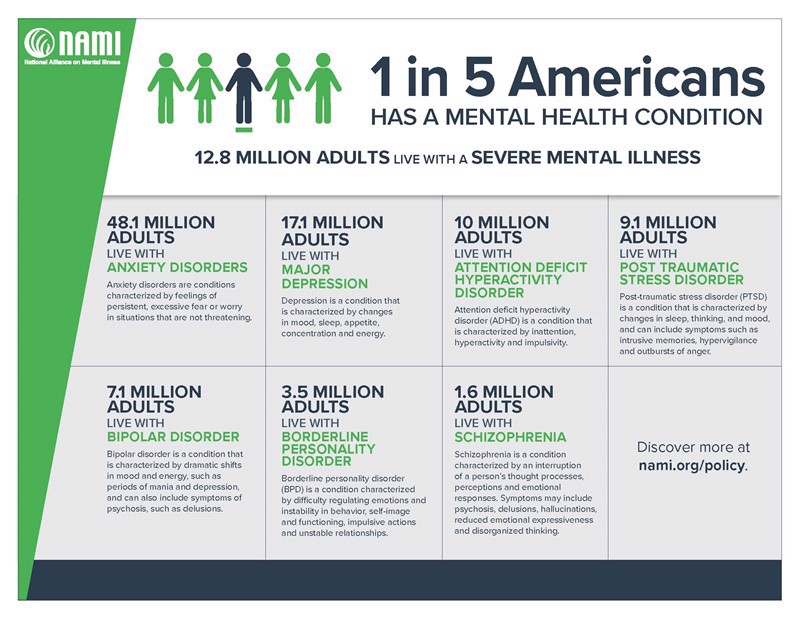
ONE IN FIVE AMERICANS LIVE WITH A MENTAL HEALTH CONDITION
Since 1949, Mental Health America and our affiliates across the country have observed May as Mental Health Month by reaching out to millions of people through the media, local events, and screenings.
This year, the theme of MHA’s 2022 Mental Health Month Toolkit is “Back to Basics.” After the last two years of pandemic living, many people are realizing that stress, isolation, and uncertainty have taken a toll on their well-being.
Everyone can experience mental health difficulties.  On average our brains produce 50,000 thoughts per day, and only 10,000 of those thoughts are positive! 

This is a month when people all across the mental health community join together to help spread awareness around mental illness to let people know that they are not alone.

The stigma that surrounds mental illness and mental health makes it difficult for some people to seek treatment and get the help that they need and deserve. The stigma can cause some people to feel shame about the symptoms and struggles that they are facing. They may be embarrassed to seek help for fear that others will find out, and they may feel alone in their struggles like they’re the only ones going through a similar situation.

According to the National Institute of Mental Health, there are 1 in 5 adults in America living with a mental illness, and yet, the stigma still exists, causing people to feel like they may be the only ones. This is the reason that Mental Health Awareness Month is so important.

Here are some ways that you can participate to bring more awareness:

1.) Share your story.

2.) Educate Yourself On Mental Health And Wellness.

3.) Talk to a therapist.

Some people mistakenly believe that therapists are only able to help people with mental illnesses such as schizophrenia or obsessive-compulsive disorder. Many mental health challenges impact people daily. This includes things like anxiety and depression or troubled relationships.

4.) Focus on your self-care.

Self-care habits include things such as getting the proper amount of sleep, making healthy food choices, getting regular physical activity into your schedule, and participating in activities that you enjoy and that help recharge you. If you’re feeling burnt out and exhausted in life, then adding self-care habits to your day may be able to help improve this.

5.) Support those around you.

When you are familiar with some of the symptoms of common mental health challenges, it can help you to identify people that may be struggling in your life. This doesn’t mean that you’re responsible or able to fix anyone, and you shouldn’t be trying to fix them. Instead, if you recognize that they may be struggling, it allows you to see how you can support them.

6.) Address any stigmas that you have.

You may be falling for the mental health stigmas that exist without even realizing it. If you want to address mental health awareness, it’s important to also look at yourself to see if you can identify any areas where you are contributing to the stigma that exists.

This can include things like believing people with mental illness are more dangerous than others or feeling like they may not be as capable in the workplace. It can also be supporting media such as TV shows that use stigmatizing language and behaviors.

7.) Download the free toolkit from Mental Health America.

It includes information about managing your feelings, toxic influences, healthy routines, and how does support connect with others. It also includes the following:

1.) Adapting after trauma and stress
2.) Dealing with anger and frustration
3.) Getting out of thinking traps
4.) Processing big changes
5.) Taking time for yourself
6.) Radical acceptance

For more information and to download the whole toolkit, click here.

If you are in crisis or are experiencing difficult or suicidal thoughts, call the National Suicide Hotline at 1-800-273 TALK (8255).

The Door SwitchTM wants to continue the fight for more awareness and provide additional resources to dispel the myths about mental health issues and solutions for safety issues. We also continue to strive to provide a product that keeps the hospital environment safe. We continue to be committed to better practices and procedures in the mental health community. For information concerning our safety product, please click here.

Sincerely,

The Door SwitchTM
New Study Shows Impact of Over-the-Door Alarms | Watch 4 Minute Video Here on Findings

New Study Shows Impact Of Over-The-Door Alarms –Health Design Reports on Findings at VA Mental Health Units
EVIDENCE BASED DESIGN 
Ligature resistance has been a focus of CMS and accrediting organizations for the past several years, but questions remain as to how far we go and where the real risks lie.
Here is what we learned in this study: 
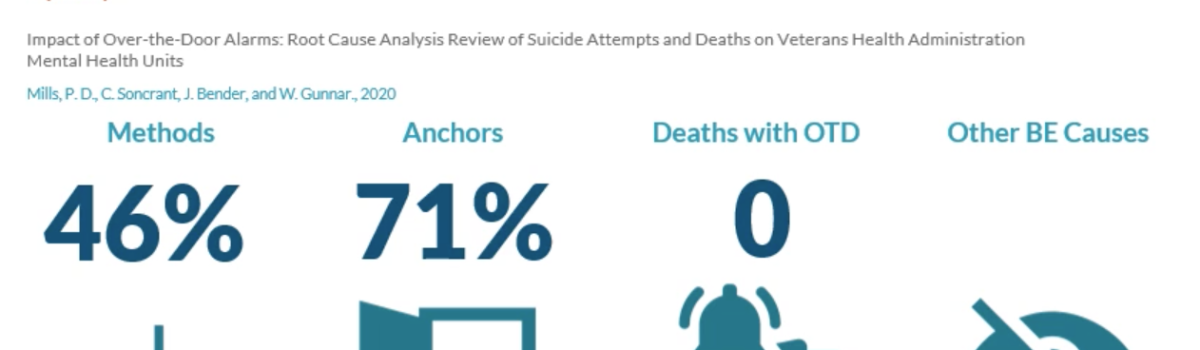
Nearly half (46%) of the suicides or attempts involved hanging, consistent with other data about the prevalence of hanging. In this study, this included 6 deaths. That’s 3.3%. The next most frequent method of suicide was strangulation with nearly a quarter (23.7%) of the recorded events, and the third most frequent, at 19.6%, was cutting – hanging was twice the number of the next method.
Of the hanging events, nearly three quarters (71.0%) used doors as the anchor point. This accounted for 4 of the 6 door-related deaths. According to the chart in the paper, the next most cited anchor point was the shower, but this was less than 7% of the time. Think about this in context 71% to 7% between the first and second most common anchor points.
Of those events where the patient was using a door, 44 of the attempts, more than a third (34.6%), involved an Over-The-Door (OTD) alarm, and none of those events included a death, suggesting the alarm helped prevent 44 deaths. Of the 6 deaths, 4 of which used the corridor doors to the bedroom, none happened on units with the door alarms.
Even knowing the alarm was there was a deterrent. Importantly, from a built environment perspective, a lack of visibility was also cited as a root cause for hanging attempts.
Can we say the results are definitive?

Correlation does not prove causation, so we can’t “prove” that OTD alarms prevented death by hanging on corridor doors.

But, it does pass the sniff test, and two attempts didn’t happen because the patients knew the alarm might alert staff, this also suggests there is a benefit to the alarms.

What’s the takeaway? 
This takeaway is pretty simple: In mental health units where the risk of patients committing suicide is high, OTD alarms may help save lives. 
However, as part of a system, the OTD acts as another layer of defense in preventing use of a common anchor point, the door. And on a final note, even though we all hear about alarm fatigue in ICUs and med-surg units, this is a different type of setting that is not plagued by the same number of alarms and alerts.Based on data, the VA has now made this a standard. This is really evidence-based design.
To read the full article reported by Health Design.org, click here.

If you are in crisis or are experiencing difficult or suicidal thoughts, call the National Suicide Hotline at 1-800-273 TALK (8255).

The Door SwitchTM wants to continue the fight for more awareness and provide additional resources to dispel the myths about mental health issues and solutions for safety issues. We also continue to strive to provide a product that keeps the hospital environment safe. We continue to be committed to better practices and procedures in the mental health community. For information concerning our safety product, please click here.

Sincerely,

The Door SwitchTM

CONTACT DETAILS

CALL US
(877)-998-5625
OFFICE
11772 WESTLINE INDUSTRIAL DRIVE
ST. LOUIS, MO 63146
EMAIL US
INFO@THEDOORSWITCH.COM

SIGN-UP FOR OUR NEWSLETTER!